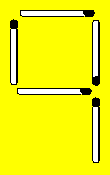
Bill Daly's Logic Puzzle solutionsIf you've stumbled upon this page by chance, the logic puzzles are here.
The blockHe's in two minds on the matter. (The block, of course, like everything else, is made of matter).
How old?Melissa is thirty. Take the vowels in their names, and assign the values a=5, e=10, i=15, o=20 and u=25. Then add up the vowel values for each name. (Allen is fifteen, being nearly sixteen.)
Two iron barsTouch the end of one (call it A) to the centre of the other (call it B). If there is a strong attraction, then A is the bar magnet. If there is negligible attraction, then B is the magnet.
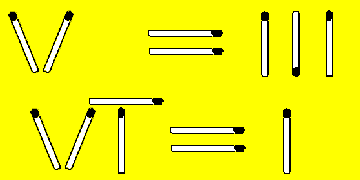
More matches
There are two alternative solutions:
(Roman) 5 = (binary) 5 (Head up=1, head down=0, or vice versa)
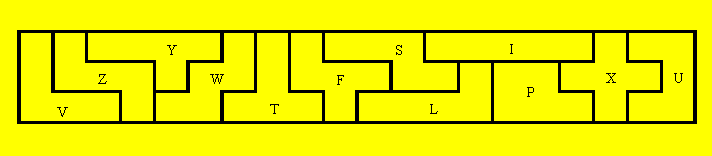
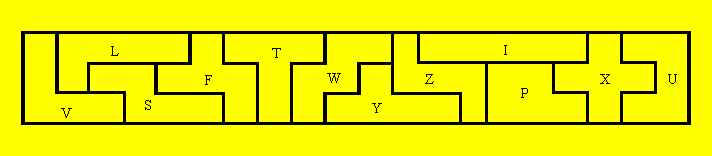
Pentominoes
2: The pentominoes are placed in the order V, L, S, F, T, W, Y, Z, I, P, X, U, as shown below:
Each of the above solutions can be turned over to give an (arguably) alternative solution.
Two balls in spaceThe two spheres are weightless, but they still have mass and so inertia. Try pushing one hand against each of them at the same time, and the difference will be obvious. The solid one will offer more resistance than the hollow one.
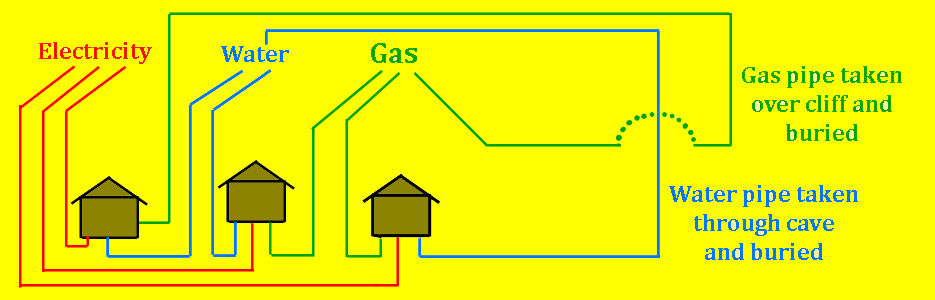
Three utilitiesIf one considers this as a problem in the plane, i.e. in two dimensions, then there is no solution. However, from a purely utilitarian point of view it can be done. Most of the pipes or cables can be laid without problems; it is only the final two that present difficulty. The two companies laying these two simply run them side by side to the nearest spot where there is a cave in a cliff face or something similar. Then they diverge. One goes up, and across the cliff top. The other goes down to the cave mouth, and runs in through it, and then up through the cliff to come near to the surface the other side of the first cable. Then they run them back to the houses. Of course, it could be an expensive exercise if the nearest cave is miles away, but it does solve the problem.
The extra squareThere is no extra square. The "diagonal" of the rectangle is in fact not a straight line, but only appears to be so because the angles of the edges along it are so similar. There is actually a long thin gap in the shape of a parallelogram between these edges, and the area of the parallelogram is exactly one square unit. So the area enclosed by the edges of the rectangle is 34x13=442, but the area of the pieces is 442 less the area of the gap. The three measurements in the diagram are three consecutive Fibonacci numbers. This puzzle works with any three consecutive Fibonacci numbers, but as the numbers chosen move up through the series there is alternately a gap then an overlap of pieces in the rectangle.
"Now, I know..."
It is a mnemonic for the first 9 digits of 𝞹 (pi) - 3.14159265
A little light verseSpoken aloud, it is (almost) the following nursery rhyme:
Sing a song of sixpence, (There are many variations of the rhyme, as it goes back at least to 1744, but this is the first verse of the version I learned as a child.)
One hundred
The solution given most often is:
Possibly the one using the fewest signs (and no brackets) is:
Some others are:
Still more matches
The bottom left match is placed across the top to give a "9". (9 is the square of 3).
Matches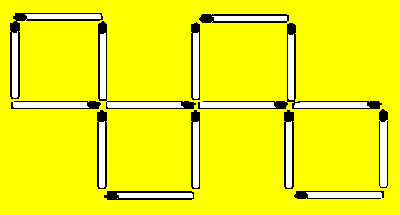
Date changeAlways. Octal 31 always equals Decimal 25.
Odd ones out1: 57. The others are prime numbers. 2: Rats. The others are languages. (Sorry, that is rather obscure!) 3: Static. The others are anagrams of composers' names: Elgar, Verdi, Chopin, and Haydn.
Knights and Knaves 2
B claims that A said he (A) is a knave. No knight would lie and say that he's a knave, and a knave would not tell the truth and say it. Therefore A did not say that, and so B is a liar and thus a knave.
Something entirely differentThere is, as I said, no set solution. These are merely a few thoughts that occur.The sun and the moon would, of course, rise in the west and set in the east. The day would be a little shorter, but there would be more days in a year. Perhaps our measurement of time and our calendars would be entirely different as a result. Weather patterns would be different, as the Coriolis effect would be reversed and so the movement of air masses would be altered. I'm sure there's much more that I haven't thought of. I've had an email suggesting that toilets, shower drains, sinks, etc. would drain in the opposite direction. I don't know whether it's true that water draining from sinks and such does indeed swirl clockwise in the Northern hemisphere and anti-clockwise in the Southern, but if that's so then the direction would indeed be different in this scenario.
Knights and Knaves 1There are many possible solutions. One would be to ask: "If I were to ask you whether you are a knight, what would you answer?" If you did ask an inhabitant if he were a knight, he would answer yes (a knight truthfully, and a knave falsely). Thus if you ask the above question, the true answer can only be yes. So a knight will say yes to that question, and a knave will say no. In fact, each answers exactly as if they were truthfully answering the question "Are you a knight?"But there is a much simpler type of solution. In Werner Herzog's film The Strange Enigma of Kaspar Hauser, Kaspar is being interrogated with a view to establishing his powers of reason. He is given this problem, and infuriates his questioners by replying that he would ask the inhabitant, "Are you a tree-frog?" Here the knight will of course answer no, and the knave yes. And that is all that is needed. Any question with a self-evident truth as answer will show whether the inhabitant is a knight or a knave.
The portrait
He is looking at a picture of his son.
Black King1: He would be stalemated at h1. 2: He would be checkmated at e3. 3: He would be checkmated next move at a8. (Qc8 mate). 4: He can never be checkmated at h1. (Because he is already stalemated).
Back to: The extra square solution
|